豪杰春香
第二次逮捕尹锡悦或是“最后一战”:“车墙堡垒”之下,先抓警卫处处长还是动用直升机?_我的网站

A |
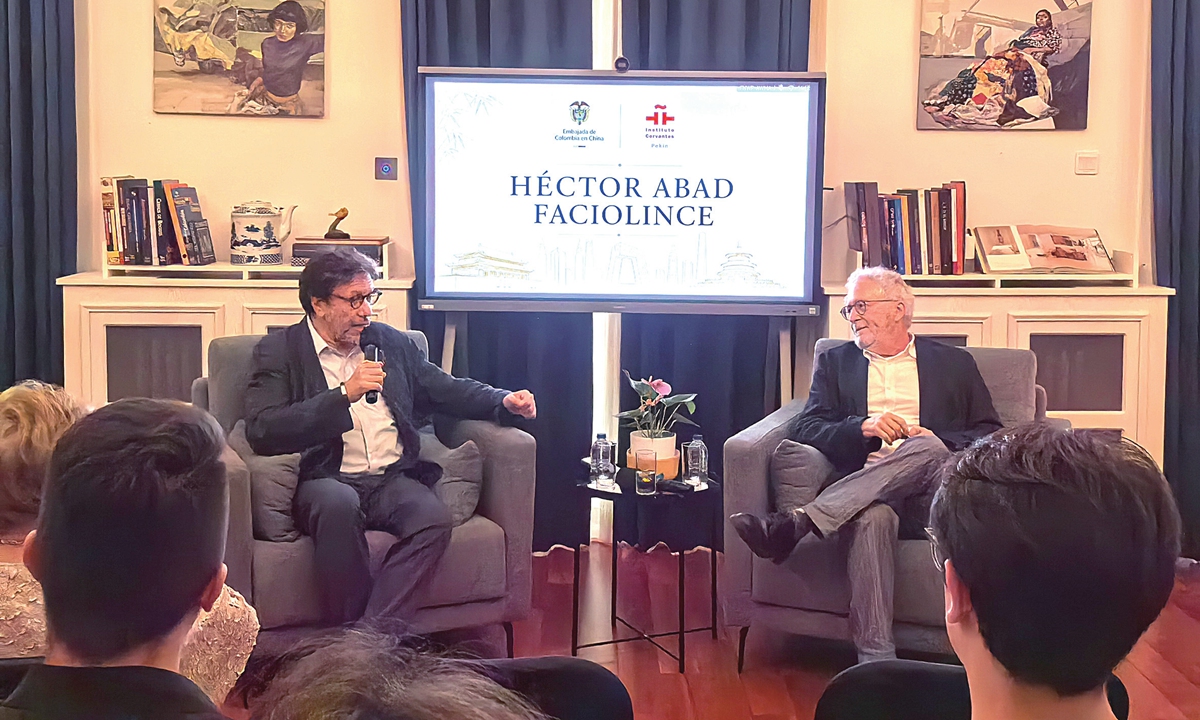
Santiago Gamboa, writer and minister counselor of the Embassy of Colombia in China, (left) and Héctor Abad Faciolince, a Colombian novelist, writer and journalist at a sharing session at the Embassy of the Republic of Colombia in China on August 18, 2026. Photo: Dong Feng/GT
The Embassy of the Republic of Colombia in China hosted a colloquium with Héctor Abad Faciolince, a Colombian novelist, writer and journalist. The writer shared on Tuesday his growth journey from a journalist to achieve his dream as a writer, his observation of the Colombian society and his impression about the changes in China.
In a fully packed hall, Minister Plenipotentiary Jose Fernando Bermúdez Cendales said in his opening remarks that the event is part of an initiative to bring Colombian culture closer to the Chinese public while simultaneously creating new spaces for dialogue and exchange between the two countries.
Bermúdez said that Abad's visit to China offers a particularly valuable opportunity to showcase the richness of our literature and to strengthen the cultural and human bridges connecting Colombia and China.
The session, chaired by Santiago Gamboa, writer and minister counselor of the Colombian Embassy, focused on the career and body of work of Abad and in particular,
El olvido que seremos (Oblivion: A Memoir).
Abad's book is a seminal work of contemporary Colombian literature in which personal and family memory engage deeply with Colombia's recent history. Its translation into Chinese allows this story to reach new readers and represents an extraordinary opportunity to bring both societies closer together through literature, per some commentators.
"We hope this gathering will be an open conversation among cultures, readers, and experiences, and a new expression of the friendship that Colombia and China continue to build," said Bermúdez.
Abad, one of the most important voices in contemporary Latin American literature, shared with the Global Times that this is his second trip in China. The last time he visited the country was two decades ago.
This time, in his eyes, China has changed a lot. In many ways, the country stands for the future of the world.
Abad said he is surprised to see how much Chinese people are depending on the electric devices and network to communicate in a virtual world, and said that he felt "like an alien."
Talking about his interaction with readers in Shanghai, Abad smiled, saying that the readers selected some phrases from his book and asked him to write down as part of the autography and signature for them.
In his book,
El Olvido Que Seremos (The Oblivion We Will Be), which is acclaimed as a "love letter from a son to his father," is not only a deeply affectionate look back at familial bonds but also a courageous attempt to defy oblivion.
Rooted in true events,
The Oblivion We Will Be chronicles the life of his own father. Abad noted that his father was killed in August 1987 - nearly forty years ago.
In the Western literary tradition, a father is often portrayed as a distant or even negative figure. His father, however, was "totally different - a man of love and deep sense of responsibility in both the public sphere and his family life."
Such image of a benevolent, non-authoritarian father has impressed his Chinese readers as well, he said.
As a physician, Abad's father dedicated his life to addressing fundamental issues affecting people's well-being, such as drinking water quality and public health, steadfast in the belief that the world could be made better through action.
Abad's work addresses themes such as memory, violence, inequality, and the human condition, deeply marked by the murder of his father, an event that inspired his most iconic book, The Oblivion We Will Be was published in Chinese by Writer's Publishing House in Beijing in July.
。 1月6日,韩国首尔,韩国国民力量党党首金起炫(中)与保安人员一起走在道路上,公交车封锁总统官邸入口。图据视觉中国据央视新闻报道,当地时间1月8日下午,韩国总统尹锡悦的代理律师尹甲根表示,如果调查机关对尹锡悦进行起诉或申请拘押,尹锡悦将配合相关司法程序,但尹锡悦一方不接受首尔西部地方法院签发的法令。若首尔中央地方法院签发逮捕令,尹锡悦方面表示将会进行配合。报道称,在首次逮捕令失效后,韩国首尔西部地方法院7日已批准延长针对尹锡悦的逮捕令期限。韩公调处处长吴东运称,为了成功抓捕尹锡悦,逮捕令有效期暂时不会公开。随着时间的拖延以及总统官邸外的集会规模越来越大,韩国当局面临的压力也越来越大。据悉,吴东运已经向议员们保证,下一次抓捕行动就是最后一次行动,“公调处和韩警方已下决心要抓到总统。”尹锡悦“逃离官邸”?代理律师否认据报道,吴东运7日在会议上被问及“尹锡悦是否在官邸”时,表示“我不清楚”。在被问及“尹锡悦是否已经逃走”时,吴东运则回答称,“正在考虑各种可能性。”这种模糊的回答引发了有关“尹锡悦已经逃走”的传言。8日,韩国在野党议员在接受采访时声称,“有消息表明尹锡悦已经离开住所,藏匿在其他地点。”对于“尹锡悦不在总统官邸”的说法,尹甲根予以否认,称自己7日才前往总统官邸与尹锡悦见面。尹锡悦的代理律师尹甲根(中)。图据央视新闻另据报道,韩国警方8日就相关说法回应称,总统的所在地点不宜公开,但将持续追踪总统的位置。韩警方现在能确认的是,从1月3日至本周早些时候,尹锡悦一直在官邸中。总统官邸外筑“车墙”韩警方或考虑部署直升机有报道指出,尽管吴东运已经承诺将做好万全准备,但想要抓到尹锡悦仍然很难。目前,韩国总统官邸的防守工作已经做得非常严密,总统警卫处人员用多辆大巴车封住了入口,筑起了一道“车墙”。

B | 门口还设置了路障,就连大门上方都安上了层层铁丝网围栏。有媒体形容称,现在的总统官邸简直就像是一座堡垒。韩国总统官邸入口处的防守工作根据韩国陆军9日向在野党共同民主党籍议员杨富男办公室提交的一份资料显示,接受总统警卫处指挥并负责总统尹锡悦警卫工作的首都防卫司令部第55警卫队人数近五年来增加了260多人。

C | 截至6日,在第55警卫队任职的人员有580多人,加上在总统官邸外围执行护卫任务的超200名人员,现在保护尹锡悦的人数已多达近800人。据报道,韩国警方现在正“特别关注”总统警卫处处长朴钟俊,并考虑是否要先逮捕这名“坚决守护总统”的官员。有分析认为,警方在逮捕尹锡悦之前可能先寻求对朴钟俊的逮捕令。警方现在正在制定策略,欲在这次逮捕行动中最大限度地部署人员和设备,以确保进入总统官邸。有猜测认为,韩国警方可能还考虑在总统官邸上空部署直升机,以便能迅速从空中通道进入总统官邸并抓住尹锡悦。此外,还有说法称,警方可能利用警车或装甲车撞开总统警卫处设置的路障,直接闯入总统官邸。曾担任过检察官的律师李东玄(音译)在接受采访时分析称,执法人员可能在警卫处以及总统官邸外支持尹锡悦的聚集人群放松警惕时,对尹锡悦实施抓捕。红星新闻记者 黎谨睿 综合央视新闻(唐鑫)编辑 张莉 责编 李彬彬(下载红星新闻,报料有奖!)。
Current article:http://khk0iw.cengzaodengchawonin.cyou/news/20260826_6647.html
Published on:21:16:38


